Project overview
The Radar and Communication Console is an interactive prop built for The Northern Outpost e.V., the Star Wars fan club in Hannover. It lives on their stand at events, where it is not a display piece behind a rope but something visitors are meant to walk up to and operate.
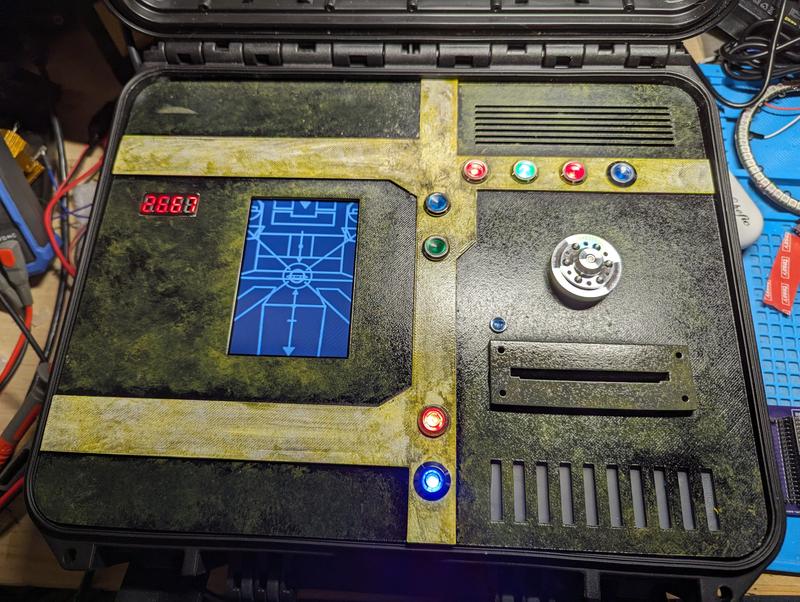
The interaction runs on cards. Laser-cut acrylic cards, bought in rather than made here, were each fitted with an RFID tag, so the console recognises which card has been pushed into the slot and calls up the matching content. Three kinds of card exist: blueprints of Imperial ships, profiles of club members, and the plans of the Death Star.
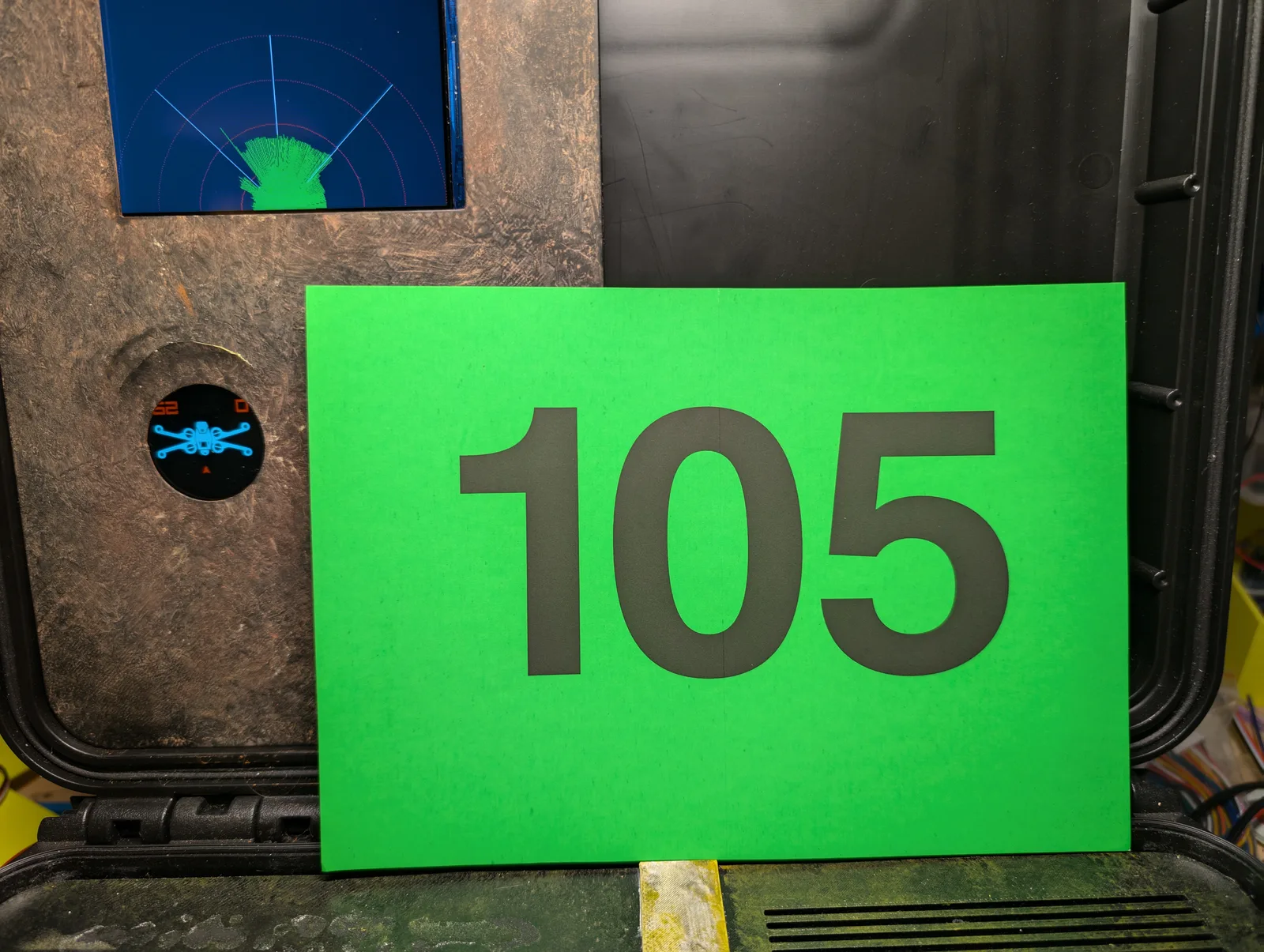
The lid carries a second, independent function. An HC-SR05 ultrasonic sensor measures the space in front of the console, and the readings are drawn as a sweeping radar picture on the second four-inch screen, so the prop reacts to people standing near it even when nobody is holding a card. Below it sits the round GC9A01 with an animated X-wing and a numeric readout.
This project is not open source. It was built to commission for the club under the Devious City License, and no design files, board files or firmware are published — the page documents how it was built, not how to rebuild it. Star Wars and all associated names, ships and designs are the property of Lucasfilm and The Walt Disney Company; this is a fan-made prop for a fan club, and none of those elements are covered by that licence.
Electronics and control
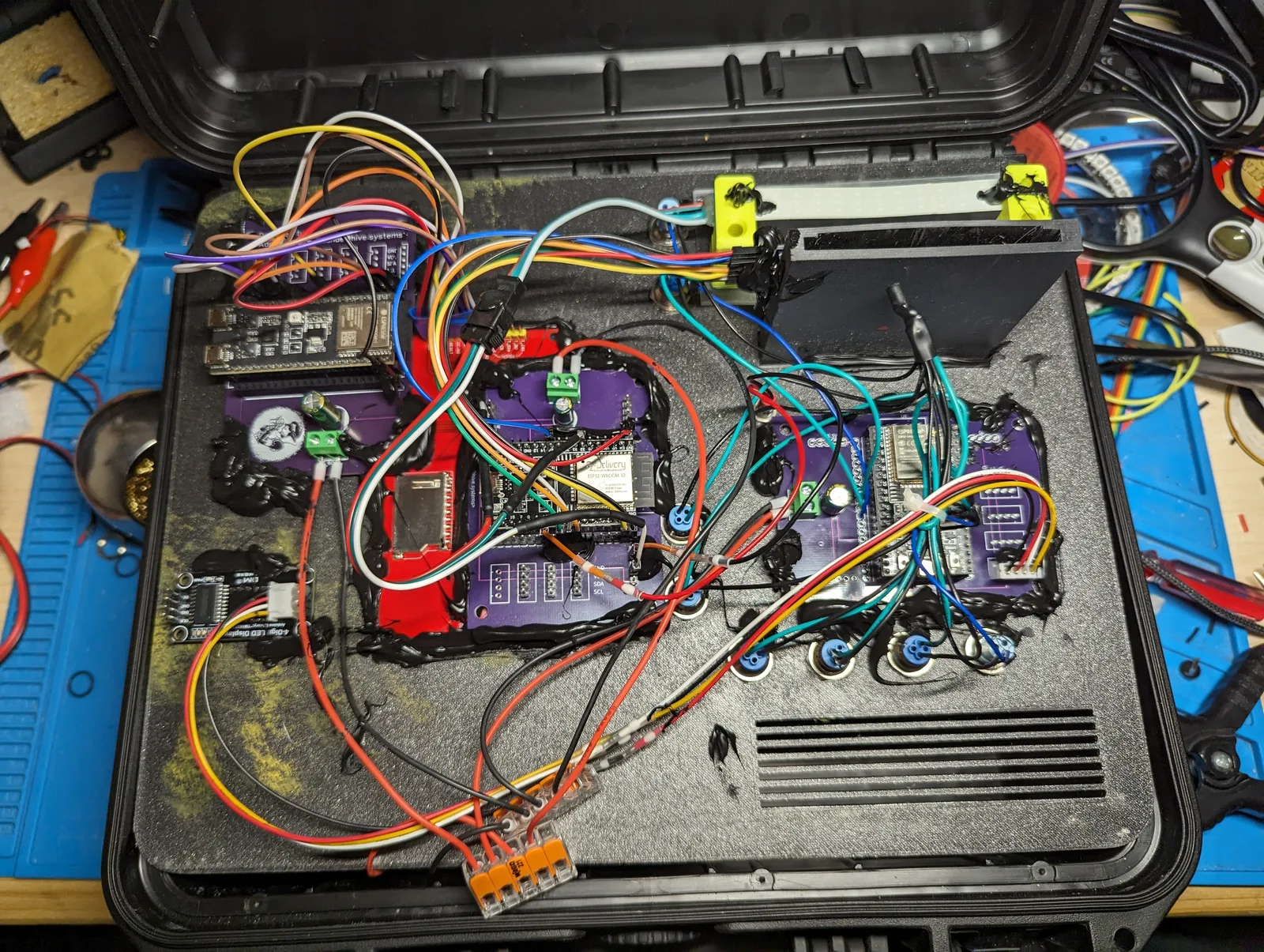
The console runs on three ESP32 boards rather than one, split strictly by task: one handles the RFID reader and the displays, one drives the lighting, and one runs the radar. That split is the central design decision of the build, and it came out of the first attempt rather than the plan.
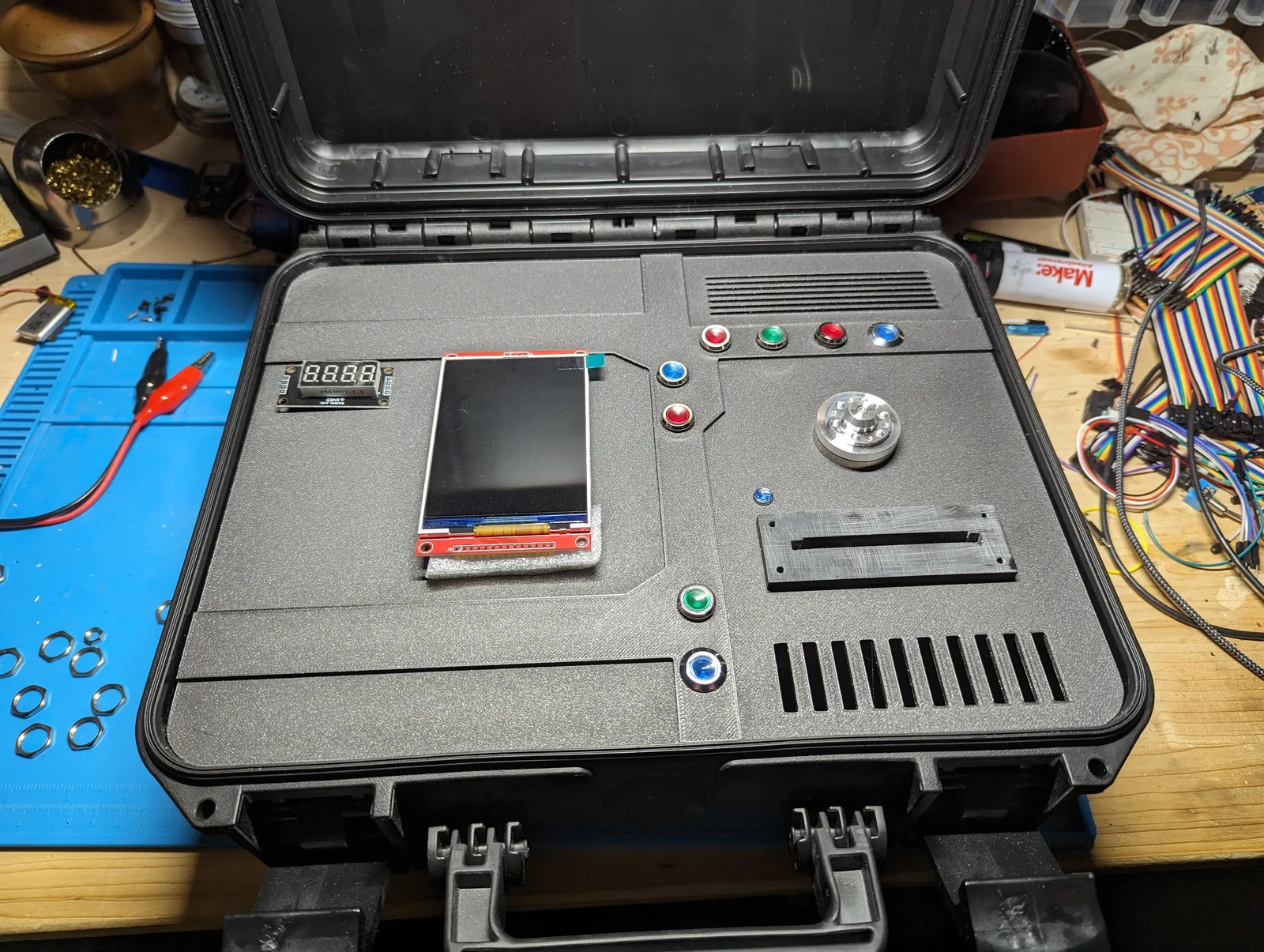
Card reading is done by an MFRC522 module behind the slot, with a tag embedded in each acrylic card. Output is spread across several devices. Of the two 4-inch TFT screens, one sits in the panel and shows the blueprints and card content, while the other sits in the lid and carries the radar sweep. A GC9A01 round LCD below it runs an animated X-wing with a numeric readout, and a four-digit seven-segment display sits beside the main screen. Twenty-six WS2812B LEDs light the panel and the illuminated buttons.
A fan keeps air moving inside the closed transport case. With three controllers, three displays and a full strip of addressable LEDs in a sealed plastic shell, it is not optional.
Mechanical construction
The whole console is built into a black transport case, so the prop travels to an event as a closed box and opens into a working station. The front panel was printed on a Qidi X-Max 3; the card slot, which needed a finer surface and tighter tolerances than the panel, was printed separately on an Anycubic M5 Pro.
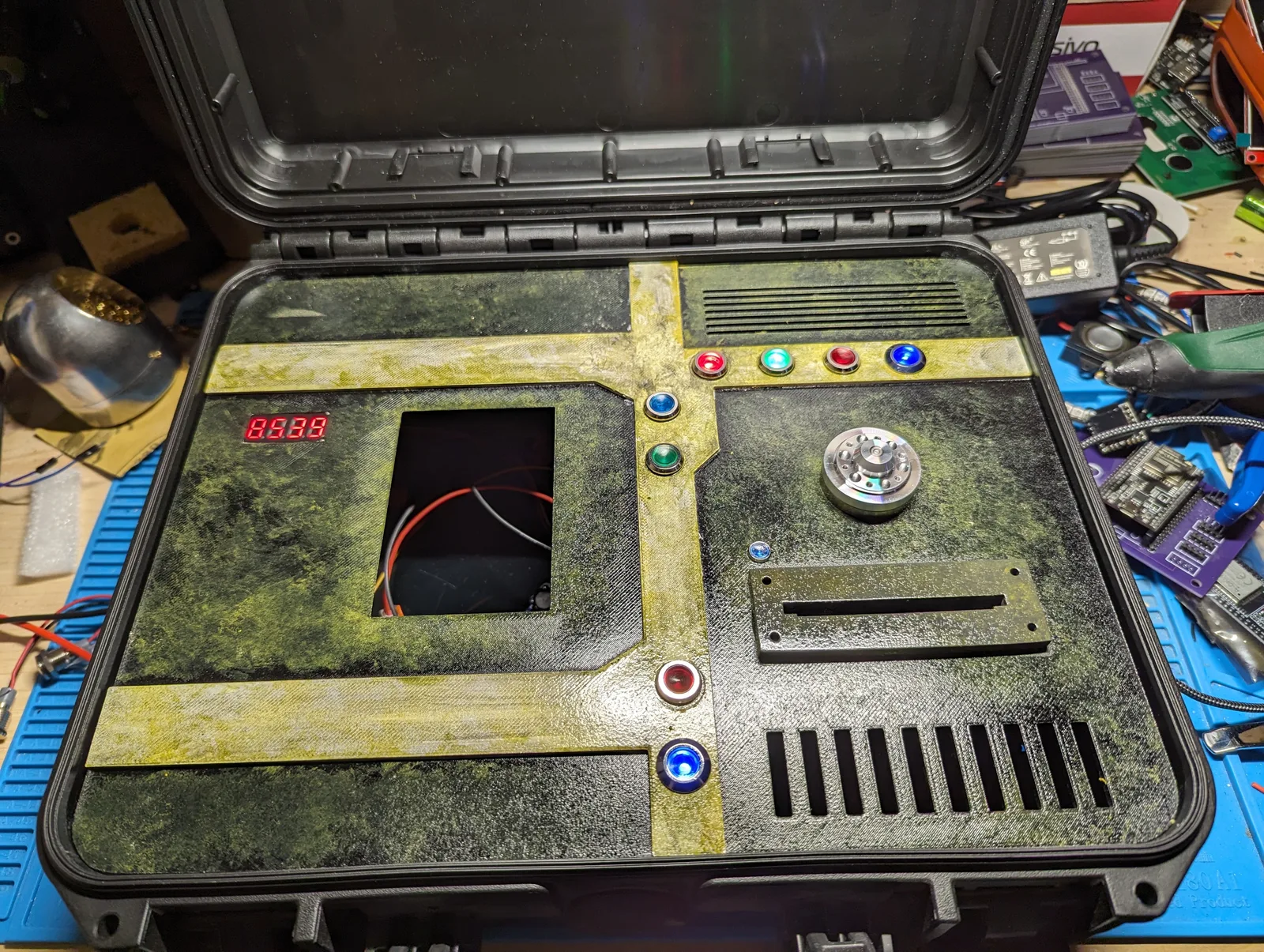
Finishing follows the same route as the Fallout modules: base colours first, then weathering with pigments and washes to take the printed surface back from new plastic to something that looks recovered from a hangar.
One panel element is not printed at all. The polished disc beside the card slot is the clamp that holds the platters onto the motor of a hard drive, reused as decoration. It is machined, concentric and already the right kind of industrial-looking object, which is not something a printed part achieves at that size.
Software
The card in the slot selects what is shown: the reader returns a tag ID, the ID maps to a content set, and the displays are redrawn accordingly. The radar controller works independently of all of that, converting the HC-SR05 distance readings into the sweep on the lid screen, so the two halves of the console never wait on each other.
Lessons learned
One ESP32 can do a lot, and then it cannot. Driving displays, an RFID reader, addressable LEDs and a radar sweep from a single controller is the kind of load that looks feasible on paper and falls apart in practice. Splitting the work across three boards, one per functional area, was what made the console behave reliably — and three ESP32 modules cost less than the time spent trying to make one keep up.
Glue does not hold a display that the public can reach. Visitors press on screens. It is not misuse, it is what people do with a panel that looks like it should respond to touch. The TFTs need a real mechanical mount that takes the force into the panel; a bonded display works on the bench and fails at the first event.
A prop like this is where the parts drawer pays off. Salvaged components that would look wrong anywhere else fit straight into a set-dressing context. The hard drive spindle clamp is the clearest example: no design work, no print time, and it reads better than anything that could have been modelled for the same spot.